
On-domain ordering: the customer now finishes a purchase without leaving our own site.
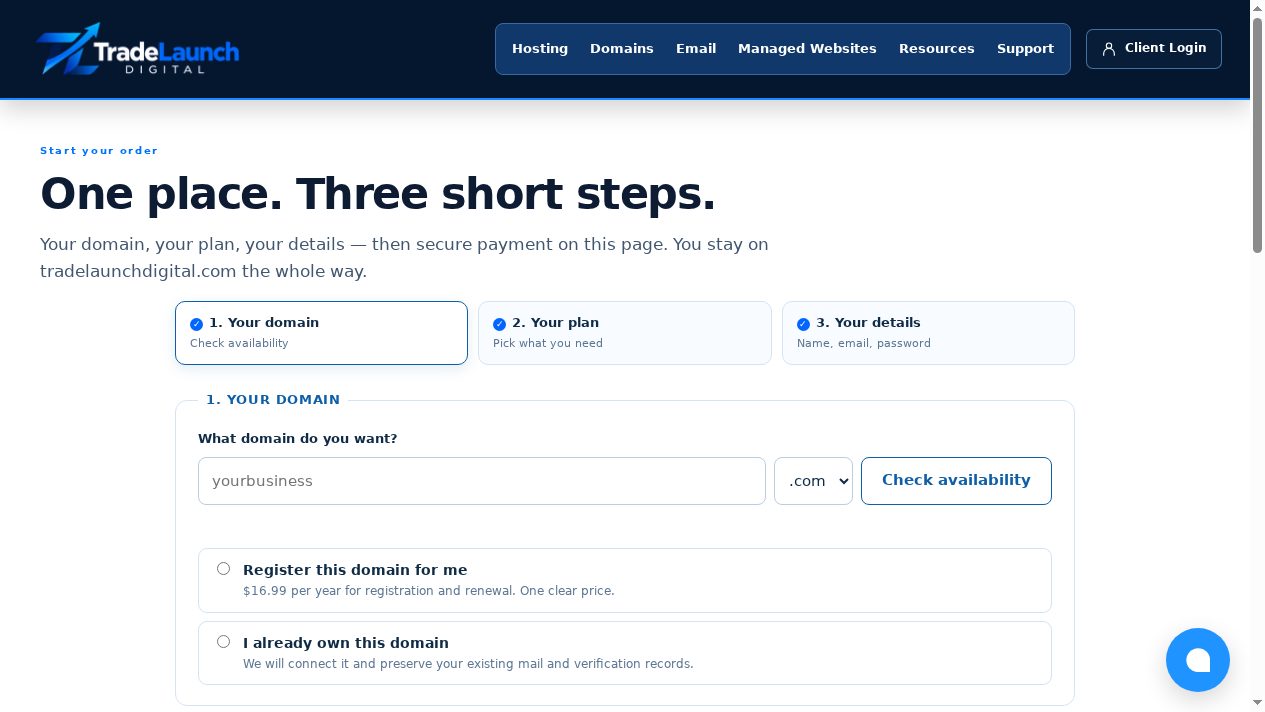
For years the marketing site sent buyers away to do the important part. Choosing a plan was easy on tradelaunchdigital.com. Registering a domain, paying, and then getting back to manage the account all happened somewhere else. In November 2026 we moved that path onto our own domain, so a customer can now start and finish a purchase without leaving the site they arrived on.
The checkout that had stopped working
The order form on the marketing site was still wired to an internal API that had been retired. The published JavaScript bundle bound a checkout form, bound a set of plan buttons and posted to /api/checkout, which answered 405. A second probe to /api/billing-status answered 404. The page looked finished and the button looked live, so the failure only surfaced once a buyer pressed it.
Two things were wrong at once. The checkout path was dead, and the whole purchase happened off-domain. A customer who landed on a trade page, picked a plan and then got redirected to register their domain had been handed between two systems with no shared account.
This is infrastructure TradeLaunch Digital built and released for its own site. It is a billing and account project; it does not represent a plumbing, HVAC or landscaping customer, or a promised business result.
Three routes, one account, one source of truth.
The work shipped as four owner-approved release phases on 8 November 2026, each one reversible and each one recorded in the tree's append-only release log.
| Piece | What it does | Why it matters |
|---|---|---|
| The order page | A three-step form on our own domain: domain, then plan, then name, email and a password | The buyer stays on the site from first click to payment |
| The payment step | Card details are entered on the page and processed by Stripe, with the order saved if the window is closed | The card number never reaches TradeLaunch, and an abandoned checkout is recoverable |
| The client account | An account area on our own domain for the customer to sign in and manage the service | One identity for the purchase and everything that follows it |
| The confirmation | A separate paid page that the order is redirected to once payment clears | There is a distinct place to confirm what was bought |
| The portal link | One configuration file holds the canonical portal address, and a script regenerates every reference from it | Moving the portal becomes one edit and one run, not a hand-edited page sweep |
Before the change the portal address was written into 129 places across 59 files. After it, the same address is generated from a single configuration value. The retired checkout code was removed from the published bundle rather than left dormant behind a dead button.
Every phase ran the same way.
Each phase used one guarded release script with the same five properties, so a mistake in one phase could not quietly become the state of the site.
- Every changed file is backed up outside the release tree, never inside it.
- Each edit is anchor-checked: the expected text must appear exactly once, or the script stops before writing anything.
- The content manifest is re-hashed for changed files only. A key that already existed can never quietly drop out.
- The whole manifest is checked against disk before it is written, and the release log is appended to, never rewritten.
- The procedure is first proved against a throwaway copy of the tree, on a real server, with the pages actually fetched, before the live tree is touched.
Phases one and two made the portal address configurable and published the order flow. Phase three published the client account and repointed 104 sign-in links and 21 buy links to the new pages. Phase four expanded the package detail behind the pricing table and took the homepage domain search off the external portal.
Open the pages yourself.
None of this needs to be taken on trust. Every claim on this page can be checked against the live site or the release record.
| Claim | Where to check it | What you should see |
|---|---|---|
| The order flow is published on our own domain | /order and /order/paid | Both answer HTTP 200 and load the three-step order form |
| The customer can manage the service in one place | /account | The client account page, on our own domain |
| The dead checkout code is gone | The published app bundle | No checkout-form binding, and no call to the retired checkout or billing-status endpoints |
| The release is recorded and reversible | The release tree's audit log | One entry per phase, each naming the backup directory it wrote |
| The portal address is generated, not hand-typed | The portal config file on the host | One canonical base URL and the script that regenerates every reference from it |
What this page does not claim: it does not report an order count, a conversion rate, a ranking change or a revenue figure. We do not publish those numbers for a project, and we cannot promise a business result. The honest statement is narrower and stronger than a metric: the pages are published, they answer, and the procedure that put them there is written down and reversible.
The same commercial facts as the rest of the site.
Moving the checkout changed where a customer buys, not what they pay. The published prices are unchanged: a fully managed website is $79 per month in total with no setup fee, and standalone hosting runs $5.99 per month for Launch, $10.99 per month for Grow and $18.99 per month for Scale, with 10 GB NVMe, 30 GB NVMe and 75 GB NVMe storage respectively. Domain registration is $16.99 per year for a one-year .com, .net or .org.
Search rankings and enquiry volumes are not guaranteed. TradeLaunch Digital works remotely across the United States; this page does not represent a local office in Arizona or North Carolina, and it is not a customer project or result.
Where to go next.
Our work page carries the full set of projects and the sample designs we build for each trade, with the same limits stated plainly: what was built, and what is not being claimed.
- Our work — the projects TradeLaunch Digital has built, and the trade website demos.
- Website templates — the starting layouts a managed website is built from.
- Managed websites — what $79 per month includes.
- Guides — cost and planning guides for trade businesses.